AMD Xilinx block RAM sizing
Compare block RAM aspect ratios for a logical memory. The estimate includes width lanes and depth banks so that narrow, deep, or unusually wide memories are accounted for.
Calculator
How the estimate works
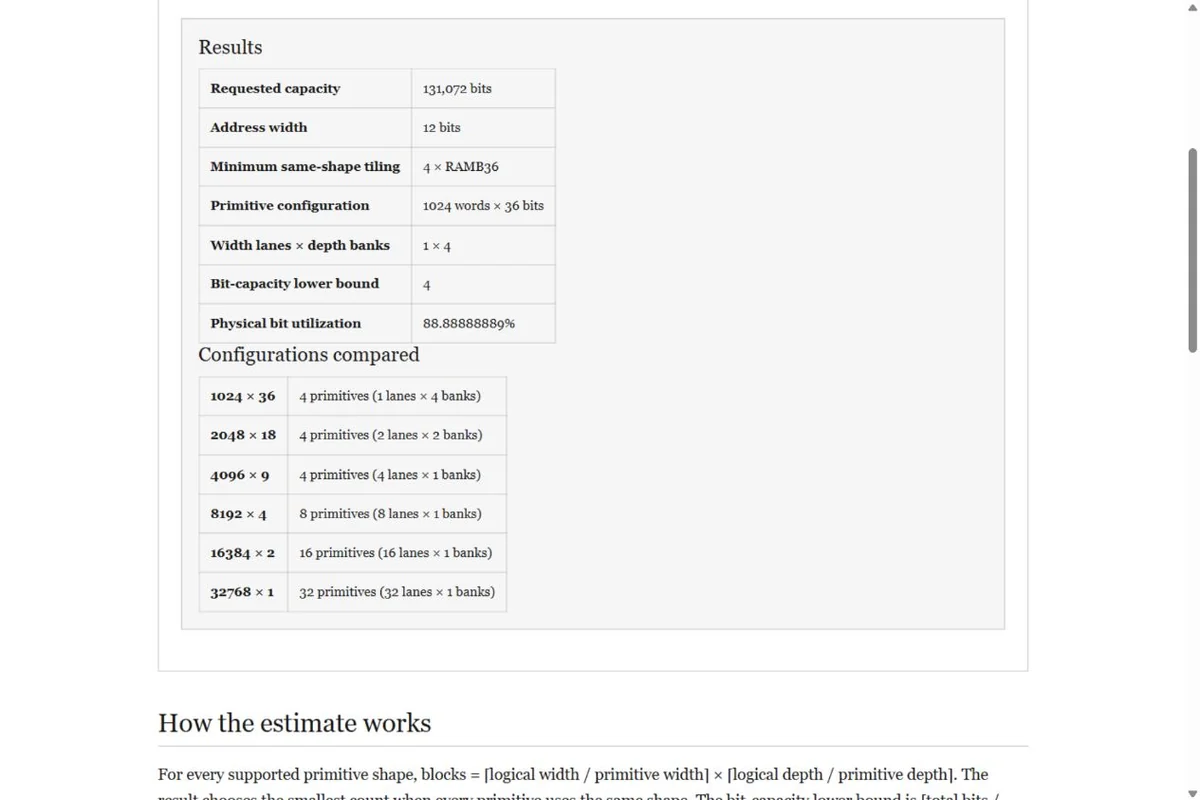
For every supported primitive shape, blocks = ⌈logical width / primitive width⌉ × ⌈logical depth / primitive depth⌉. The result chooses the smallest count when every primitive uses the same shape. The bit-capacity lower bound is ⌈total bits / primitive capacity⌉.
The RAMB18 configurations are 16,384 × 1, 8,192 × 2, 4,096 × 4, 2,048 × 9, and 1,024 × 18, with 512 × 36 in simple-dual-port mode. RAMB36 doubles the depth for the shared widths, adds 1,024 × 36, and supports 512 × 72 in simple-dual-port mode.
Worked example
A 4,096 × 32-bit memory maps to four RAMB36 primitives in 4,096 × 9 mode, or four in 1,024 × 36 mode. The best same-shape count is four and physical bit utilization is 88.89%.
Scope of the estimate
These shapes apply to 7-series RAMB18E1/RAMB36E1 and UltraScale RAMB18E2/RAMB36E2. The calculation assumes equal read/write widths, available parity storage as data, and ECC disabled. Simple dual port means one read port and one write port.
Mixed-shape packing, asymmetric ports, byte-write enables, ECC, cascade constraints, extra read ports, and synthesis choices can change usage. Confirm the final result in Vivado synthesis and implementation reports. A one-word memory needs zero address bits mathematically; an HDL interface may still require a minimum one-bit address signal.
Related tools
- Fixed-point converter — Determine the word width and fractional precision of stored samples.
- DDS tuning-word calculator — Calculate the phase step for an oscillator using a waveform lookup table.
- VHDL entity and testbench generator — Create a starting interface for a memory wrapper and its testbench.